
 Wave
Wave
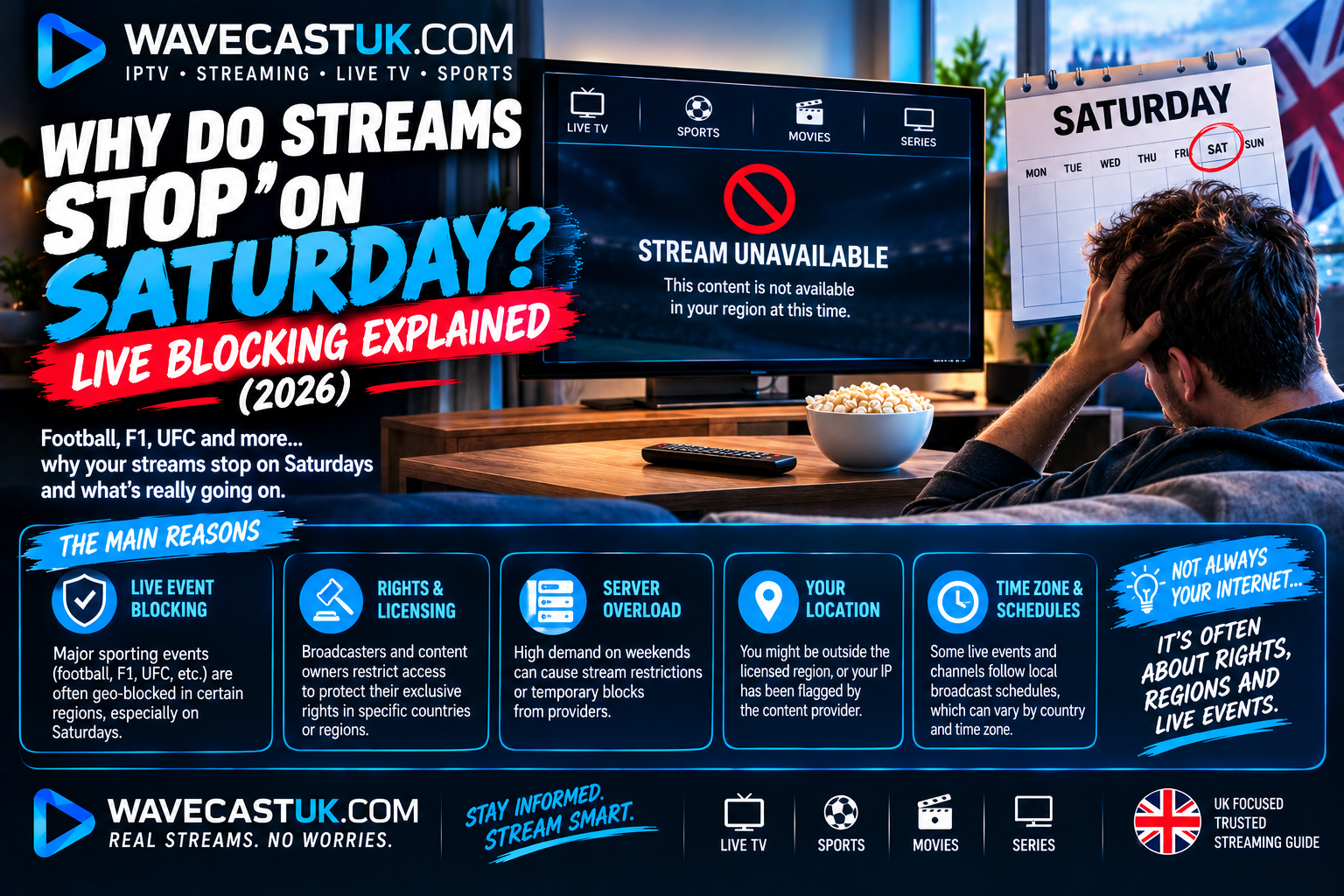
Why Do Streams Stop on Saturday? Live Blocking Explained
If you've ever asked yourself why do streams stop on Saturday afternoons specifically — not randomly, not on other days, but right around 3pm — you're not imagining a pattern. There is one, and it isn't a coincidence or a weak signal. It's the direct result of a decades-old UK broadcasting rule combined with a modern legal enforcement system that actively hunts down and blocks unlicensed football streams in real time. This guide explains both halves of that picture: the 3pm blackout itself, and the "live blocking order" system that goes further and shuts down Streaming servers while matches are actually being played.
- The most common answer to why do streams stop on Saturday is the UK's 3pm blackout — no British broadcaster is legally permitted to show live football between 2:45pm and 5:15pm on Saturdays, a rule dating back to the 1960s.
- On top of that, the Premier League holds a High Court "live blocking order" that forces the UK's biggest ISPs to block illegal streaming servers in real time, starting around 15 minutes before kickoff.
- Not every Saturday stream problem is the blackout — genuine peak-time congestion, when several matches kick off simultaneously, is a separate and very real cause of buffering.
- The short answer: why streams stop at 3pm
- The UK's 3pm blackout rule, explained
- Where the blackout actually came from
- It's not just missing TV coverage — streams get actively blocked
- How the live blocking order actually works
- Why the disruption can outlast the match itself
- When it isn't the blackout: genuine Saturday peak-load buffering
- What you can actually do about it
- Frequently Asked Questions
01The short answer: why streams stop at 3pm
The short version of why do streams stop on Saturday is this: for the specific window of 2:45pm to 5:15pm, English and Scottish football simply isn't allowed to be broadcast live in the UK, by anyone — Legal or not. That gap in official coverage is exactly the window unlicensed streams try to fill, and it's also exactly the window rights holders police most aggressively with real-time blocking technology. So the pattern people notice — a stream that was fine all morning suddenly cutting out right as a 3pm kickoff approaches — isn't a fault. It's two separate enforcement mechanisms working together, and understanding both makes the "random" Saturday outage make a lot more sense.
02The UK's 3pm blackout rule, explained
The rule itself is straightforward: no football match may be broadcast live on UK television between 2:45pm and 5:15pm on a Saturday. It's enforced by the English and Scottish Football Associations, who have the right to impose this kind of restriction under UEFA's Article 48, which gives national associations discretion over domestic broadcast windows. Most European football associations don't use this power at all — the UK is one of the few major footballing nations that still does.
In practice, this means Saturday Premier League and EFL fixtures are scheduled to kick off either early (typically 12:30pm) or late (5:30pm or later), specifically to stay outside the blocked window. Live radio commentary is exempt and remains fully legal both nationally and locally during the blackout — it's specifically live television and video streaming that the rule targets.
03Where the blackout actually came from
The rule dates back to the 1960s and is generally credited to Burnley chairman Bob Lord, who argued that televising Saturday afternoon matches would pull fans away from attending games at smaller clubs, damaging gate revenue further down the football pyramid. That argument has aged badly under scrutiny — a 2011 European Commission-linked investigation found little to no correlation between televised top-flight matches and reduced attendance at lower-league games nearby.
The blackout was actually suspended for the 2019/20 and 2020/21 seasons, when matches were played behind closed doors during the pandemic and there was no attendance to protect, before being reinstated for 2021/22. As of 2026, it's still in force, though it's an active point of debate ahead of the next domestic TV rights negotiation cycle, with some clubs reportedly pushing to have it scrapped.
04It's not just missing TV coverage — streams get actively blocked
The blackout alone would explain why licensed broadcasters go quiet at 3pm, but it doesn't fully explain why unlicensed IPTV streams specifically stop working — after all, an illegal stream isn't following the FA's broadcast schedule. The rest of the answer is the Premier League's "live blocking order," a High Court injunction first granted in 2017 (FAPL v BT & Others) and renewed every season since. It legally compels the UK's major ISPs — Sky, BT, Virgin Media, TalkTalk, Plusnet, and EE — to block servers hosting unauthorised live streams of Premier League matches while those matches are being played.
This is not a small-scale measure. In one recent season covered by the order, roughly 200,000 illegal streams were disrupted or blocked, and a related anti-piracy programme removed around 450,000 unauthorised clips from social and video platforms in the same period. Separately, UK prosecutions connected to illegal streaming operations have resulted in multi-year prison sentences for operators. This is the mechanism that actually answers why streams stop on Saturday specifically during live play, rather than just during the official blackout window.
05How the live blocking order actually works
The detection side of this system is more sophisticated than most viewers realise. According to reporting on the process, anti-piracy monitoring firms working on behalf of rights holders subscribe to pirate IPTV services as ordinary paying customers, then systematically capture and analyse the streams — including examining the underlying playlist files the service uses to deliver channels. Captured video frames are compared against the genuine broadcast feed to confirm a match is being shown without authorisation. Once confirmed, the server's IP address is logged and passed to the major UK ISPs for blocking, and reporting describes infringing streams being blocked within seconds of being flagged.
Blocking activity typically begins around 15 minutes before kickoff and continues for roughly 15 minutes after the final whistle — which lines up closely with why streams so often drop right as a 3pm match is about to start, rather than at some random point during the afternoon.
06Why the disruption can outlast the match itself
One detail that catches a lot of people out: the block doesn't necessarily lift the moment the final whistle blows. Reporting on the system notes it can take up to a couple of hours for a blocked server to become unblocked by ISPs after a match has finished, since the block is applied at the IP address level rather than being tied precisely to the exact second play stops. Because blocking is applied at the server level, and many unlicensed IPTV services run multiple channels through shared infrastructure, a block triggered by one football stream can plausibly affect other channels routed through the same server — which is a reasonable explanation for why some users report unrelated channels going down alongside the match they were actually trying to watch, even though the block was only ever meant to target the football feed.
07When it isn't the blackout: genuine Saturday peak-load buffering
It's worth being honest that not every Saturday streaming problem is the blackout or a blocking order — and conflating the two causes leads people to the wrong fix. Saturday afternoons routinely have several matches kicking off at the very same time across the Premier League and EFL, which creates a genuine, simultaneous demand spike on any streaming infrastructure, licensed or not. As our own sports streaming page explains, buffering during high-demand periods is most often traceable to home Wi-Fi congestion or available bandwidth rather than a wider outage — a wired ethernet connection during peak Saturday hours noticeably reduces the odds of that kind of stutter. The practical takeaway: if a stream drops at exactly kickoff time for a blacked-out fixture, that's very likely enforcement. If it's buffering rather than fully dropping, and it's happening across several simultaneous matches, that's much more likely to be ordinary peak-load congestion.
08What you can actually do about it
It's worth being clear about who this system is actually built to target: enforcement under the live blocking order and related UK copyright law is aimed at the operators running unlicensed streaming servers, not at individual viewers, as covered in more detail on our is IPTV legal in the UK guide. That said, relying on a stream that's liable to be blocked mid-match is never going to be a reliable way to actually watch football. During the blackout window itself, the fully legitimate options are: live radio commentary (BBC Radio 5 Live and local BBC stations cover every match, including blacked-out 3pm kickoffs), text and score-tracking commentary, and catching the fixture as an early (12:30pm) or late (5:30pm+) kickoff where one is scheduled instead. For blacked-out 3pm matches specifically, Match of the Day and equivalent highlights packages remain the standard legal route to seeing the action once the window closes. Once you know why do streams stop on Saturday afternoons in the first place, planning around it — rather than fighting a stream that's built to fail — is by far the more reliable approach.
09Frequently Asked Questions
Because Saturday between 2:45pm and 5:15pm is the UK's football blackout window, and it's also the window the Premier League's live blocking order targets most heavily, since that's when the majority of unlicensed 3pm streams are being watched.
It's a High Court injunction, first granted to the Premier League in 2017 and renewed every season since, that legally requires major UK ISPs to block servers found hosting unauthorised live streams of matches while those matches are being played.
The blackout rule itself was written for television broadcasting, but in practice it applies just as much to any live video stream of the match, and unlicensed streaming servers are the primary target of the separate live blocking order during that window.
Reporting on the system indicates blocking typically starts around 15 minutes before kickoff and continues for about 15 minutes after full time, though it can take up to a couple of hours for a server to be unblocked afterward.
UK enforcement under the live blocking order and related copyright law has focused on the operators running unlicensed streaming servers rather than individual viewers, but a blocked or shut-down stream is still an unreliable way to watch, regardless of personal legal exposure.
Not live via video in the UK — the blackout applies to all broadcasters. Live radio commentary is fully legal during the window, and highlights on programmes like Match of the Day are the standard legal route once the blackout window ends.
10Sources
- Internal editorial documentation, WaveCastUK, September 2026
- Live Football on TV — The UK Football TV Blackout Rule
- Goal.com — Why is there a Saturday football blackout in the UK?
- Premier League — High Court awards League order to block illegal streams
- Kluwer Copyright Blog — The UK's first "live" blocking order
- TorrentFreak — Inside the UK's Pirate IPTV Blocking System
This article explains publicly reported UK broadcasting rules and legal enforcement as they stood in September 2026, for general information only — it is not legal advice. This article is editorially maintained and updated periodically.
Tired of streams that vanish at kickoff?
See what a properly licensed WaveCastUK subscription actually includes.
Start Free Trial View Packages