 Wave
Wave
How Does IPTV Work? A Complete Beginner's Guide
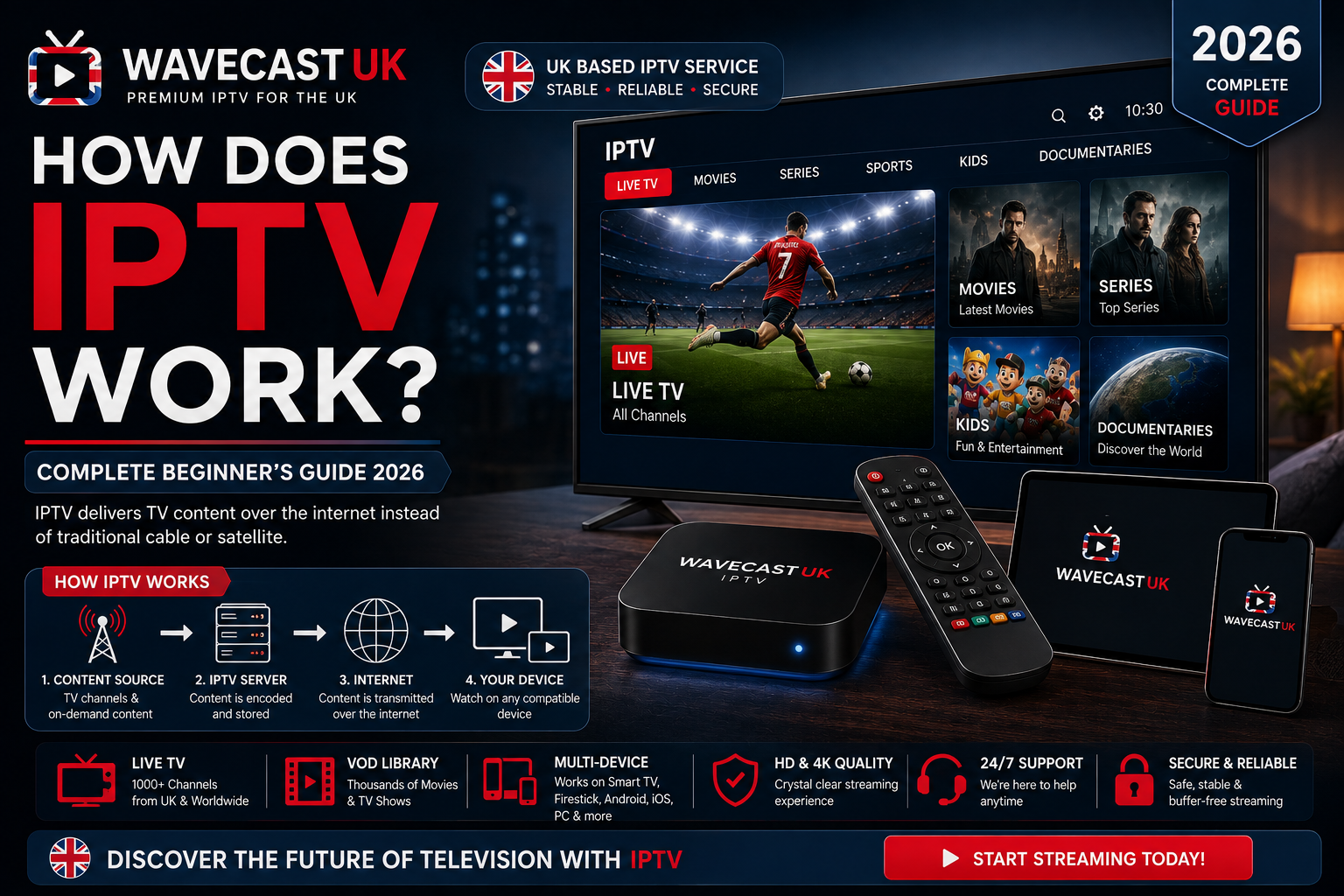
If you've ever asked how does IPTV work, the short answer is: it delivers television over your internet connection instead of a satellite dish, aerial or cable box. This guide breaks down the technology in plain English, and covers the legal side too — something most "how it works" articles skip entirely.
We're an IPTV provider ourselves, so we have a commercial interest in this topic. We've tried to write this guide honestly — including the legal realities that some sites gloss over. Judge us on that honesty.
Sources: ServerMania, TechTarget, Ofcom/CDPA Section 97A case reporting, FACT (Federation Against Copyright Theft) enforcement coverage (August 2026).
01 How Does IPTV Work, Exactly?
IPTV stands for Internet Protocol Television. Instead of a broadcaster sending the same signal to every aerial or satellite dish in a region at once, IPTV sends video as data — broken into small packets — over the internet, directly to your individual device. Your TV, streaming box or phone requests the stream, and the provider's servers deliver it to you specifically, the same basic principle behind Netflix or iPlayer, just applied to live channels as well as on-demand content.
In practice, this means a video file or live feed is encoded on a server, compressed into a streaming-friendly format, and sent to your device through an app. That app decodes the stream in real time and displays it on screen. No satellite dish, no coaxial cable, no scheduled broadcast slot required — just a stable internet connection.
02 The Technology Behind IPTV
A handful of streaming protocols do the heavy lifting:
- HLS (HTTP Live Streaming) — the most common protocol in modern IPTV, developed by Apple. It breaks video into small chunks and adjusts quality automatically based on your connection speed (adaptive bitrate).
- RTSP (Real-Time Streaming Protocol) — often used for on-demand content and IP camera-style feeds, giving more direct control over playback.
- RTMP (Real-Time Messaging Protocol) — an older protocol still used for low-latency live streaming between servers.
- MPEG-DASH — an open standard alternative to HLS, also built around adaptive bitrate streaming.
For live channel specifically, many IPTV systems use multicasting — sending one stream that many users tap into simultaneously (similar to how traditional broadcast works, but over IP networks), which is more efficient than sending a completely separate stream to every viewer. On-demand content, by contrast, is typically unicast — a one-to-one stream generated specifically for your request, which is why you can pause, rewind or restart it independently of anyone else watching.
Everything you see in your IPTV app is organised through an M3U or M3U8 playlist file, which is essentially a list of stream URLs, and an EPG (Electronic Programme Guide), which maps those streams to schedules, channel logos and programme descriptions so the interface feels like a normal TV guide rather than a raw list of links.
03 IPTV vs. Traditional TV vs. Streaming Apps
It helps to place IPTV next to the alternatives:
| Method | Delivery | Typical content |
|---|---|---|
| Satellite / Cable TV | Broadcast signal via dish or cable, same for everyone at once | Fixed channel schedule |
| Streaming apps (Netflix, iPlayer) | Internet, usually on-demand only | Licensed on-demand libraries, some live |
| IPTV | Internet, live channel + on-demand together | Live TV channel, VOD library, EPG, catch-up — in one app |
The distinguishing feature of IPTV is that it combines live, scheduled channel with an on-demand library and a proper programme guide, all inside one interface — something neither traditional broadcast nor most single-purpose streaming apps do on their own.
04 What You Need to Use IPTV
- A stable internet connection — at least 10 Mbps for HD, 20-25 Mbps for smooth 4K playback.
- A compatible device — Smart TV, Amazon Firestick/Fire TV, Android TV box, phone, tablet, PC/Mac, or a MAG/Enigma2 set-top box.
- An IPTV player app — such as IPTV Smarters Pro, TiviMate or VLC, which reads the M3U playlist and EPG data.
- A subscription or playlist URL — from a provider, giving you a server address, username and password (or a direct playlist link).
Setup is normally quick: install the app, enter your credentials, and the channel list and guide populate automatically within a minute or two.
05 Is IPTV Legal? What UK Users Actually Need to Know
This is the part most "how IPTV works" guides leave out, and it matters.
The technology itself is legal
IPTV is just a delivery method — the same one Netflix, BBC iPlayer and Sky's own streaming apps use. There is nothing illegal about streaming video over IP as a technique.
Licensing is what determines legality
What matters is whether the provider has paid for the rights to distribute the channel it's offering. If a service streams Sky Sports, Premier League matches or premium film content without a licence, that service is breaking UK copyright law — regardless of how professional its app looks.
UK enforcement is genuinely active, not theoretical. The Premier League holds dynamic "live blocking" court orders under Section 97A of the Copyright, Designs and Patents Act, which require UK ISPs to block illegal IPTV server IP addresses in near real-time during matches. FACT (Federation Against Copyright Theft) runs joint enforcement operations with the Premier League every season. In one widely reported case, a Birmingham reseller was jailed for 12 months for selling illegal Premier League streams, and the operator behind the UK's largest known piracy operation received an 11-year prison sentence. In a more recent round of enforcement, FACT issued cease-and-desist notices to 40 individuals and arrested three people in a single operation, and a separate streaming operator was ordered to pay £860,000. Operators and sellers of unlicensed IPTV services can face up to 10 years in prison under the Digital Economy Act 2017.
For individual viewers, enforcement has so far focused on operators and resellers rather than residential subscribers — there are no recorded UK criminal prosecutions of individual IPTV viewers as of 2026. That said, viewers of unlicensed services can still face warnings or fines if a provider's customer data is seized, and streams can simply stop working mid-match when an ISP blocking order kicks in. The safest approach is straightforward: choose a provider that's transparent about who it is, and be wary of any service that won't explain where its content licensing comes from.
06 How to Choose a Reliable IPTV Provider
- Transparency. A real company name, working support channel and clear terms are good signs; anonymous Telegram-only sellers are not.
- A trial period. Legitimate providers let you test stream quality and stability before you commit to a longer plan.
- Server stability during peak hours. Buffering during a big match is the most common complaint — ask specifically about capacity for live sport.
- Multi-device support. Some providers limit accounts to one device at a time; check this before buying if your household watches on more than one screen.
- Real customer reviews on independent platforms like Trustpilot, not just testimonials on the provider's own site.
- 24/7 support via live chat or WhatsApp, so you're not stuck if something breaks during an evening or weekend.
07 Frequently Asked Questions
Is IPTV the same as streaming services like Netflix?
Not quite. Netflix is on-demand only. IPTV typically combines live, scheduled TV channel with an on-demand library and an electronic programme guide in a single app — closer to a full TV replacement than a video library.
Do I need special hardware for IPTV?
No special hardware is required beyond a device you likely already own — a Smart TV, Firestick, Android box, phone or computer — plus a stable internet connection and an IPTV player app.
Why does my IPTV stream buffer during big matches?
Buffering during peak times usually comes down to server overload at the provider's end, an unstable internet connection, or a provider that hasn't invested in enough capacity for high-demand events. A wired connection and a provider with a good track record on live sport both help.
Can I get in trouble for using IPTV in the UK?
UK enforcement to date has targeted operators and resellers of unlicensed services, not individual subscribers, and there are no recorded criminal prosecutions of individual viewers. Still, using an unlicensed service carries some risk (streams can be blocked mid-broadcast, and customer data from seized operators has been used in warnings). Choosing a transparent, properly licensed provider avoids this entirely.
What internet speed do I need for IPTV?
At least 10 Mbps for HD streaming, and 20-25 Mbps for consistently smooth 4K Ultra HD playback. A wired Ethernet connection is generally more stable than Wi-Fi for live sport.
08 Conclusion
At its core, IPTV works by sending television as internet data rather than a broadcast signal — using protocols like HLS and RTSP, organised through M3U playlists and an EPG, and delivered to whatever device you already own. It's a genuinely useful piece of technology, but "how does IPTV work" isn't a complete answer without also asking who's licensing the content you're watching. UK enforcement against unlicensed operators is real and active, so the safest path is picking a provider that's upfront about what it offers and how it operates.
Want to try IPTV the straightforward way?
Test channel quality and stability for yourself before committing to a plan.
⚡ Start Free TrialSources
- ServerMania — "What is IPTV and How Does it Work?"
- TechTarget — "What is IPTV (Internet Protocol television) and how does it work?"
- Coverage of Premier League Section 97A dynamic blocking orders and FACT enforcement operations (2023–2026)
- Digital Economy Act 2017 — penalties for unlicensed broadcast/streaming operators