
 Wave
Wave
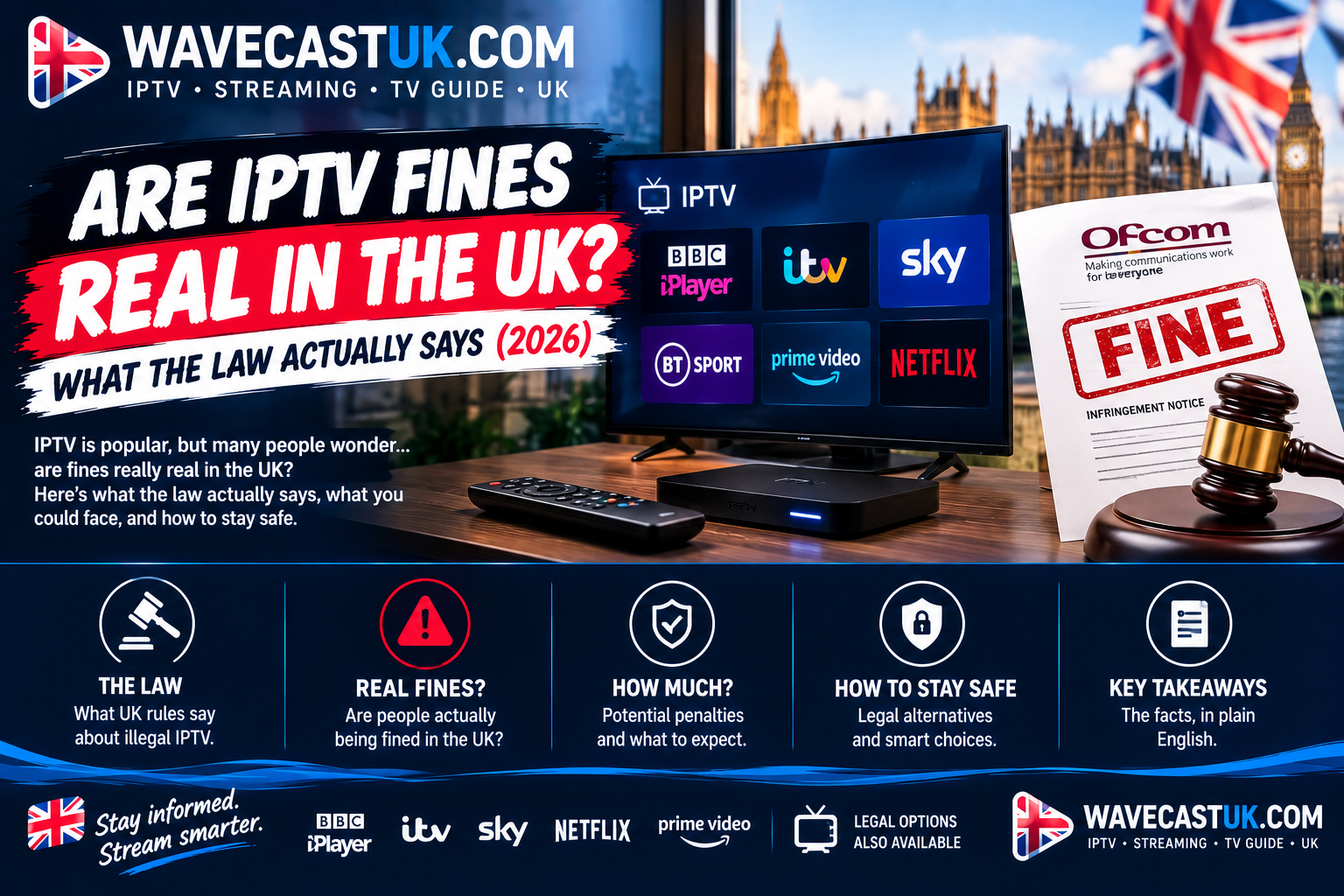
Are IPTV Fines Real in the UK? What the Law Actually Says
A plain look at the legislation, enforcement bodies, and real cases behind "illegal IPTV" in the UK — including whether ordinary users, not just sellers, can be fined or prosecuted.
Is IPTV itself illegal?
No — IPTV (Internet Protocol Television) is just a delivery method: television sent over an internet connection rather than satellite, cable, or terrestrial aerial. Services like BBC iPlayer, Sky Stream, and NOW are all IPTV in the technical sense, and they're entirely legal.
What's illegal is a specific category of service: one that streams copyrighted channels — Premier League football, Sky Sports, BT/TNT Sports, subscription movie channels — without holding a licence or agreement from the rights holder. These are usually sold cheaply through resellers, often via WhatsApp or Telegram, bundled onto a "fully loaded" Firestick or a TiviMate/IPTV Smarters Pro app. The technology is neutral; the licensing status of the specific service is what determines legality.
The laws that apply
There isn't one single "IPTV law" in the UK. Enforcement draws on a combination of existing statutes:
| Law | What it covers |
|---|---|
| Copyright, Designs and Patents Act 1988 | Makes it an offence to communicate copyrighted work to the public without the rights holder's permission — the core copyright-infringement charge used against distributors. |
| Fraud Act 2006, Section 11 | Covers obtaining services dishonestly. This is the provision most often used against both sellers and end users of illegal streams, since it doesn't require proving copyright ownership directly. |
| Digital Economy Act 2017 | Increased maximum sentencing for online copyright infringement, raising the ceiling for the most serious cases to up to 10 years' imprisonment. |
Prosecutions are typically brought by local Trading Standards teams, the Police Intellectual Property Crime Unit (PIPCU) at City of London Police, or through private prosecutions backed by the Federation Against Copyright Theft (FACT), which investigates on behalf of broadcasters and rights holders.
Can individual users be fined, not just sellers?
Most publicised cases involve resellers — the people setting up and selling the subscriptions — because they're easier to identify and the financial harm is larger. But the law doesn't only target sellers, and enforcement bodies have been explicit that users are also exposed.
FACT has run public messaging campaigns warning that end users, not just distributors, can be liable under Section 11 of the Fraud Act 2006 for knowingly obtaining a service dishonestly. There is also a specific UK precedent — the case of a Liverpool man convicted over a Firestick modification operation — that's been cited as establishing that users, not only sellers, can receive a custodial sentence.
In practice, individual subscribers are far more likely to receive a warning letter or a civil claim for damages than a criminal prosecution, simply because there are vastly more users than sellers and enforcement resources are limited. But "unlikely to be prosecuted" is not the same as "not illegal," and the legal exposure is real even if it isn't always acted on.
Real UK cases
Both cases involved resellers rather than individual subscribers, which reflects where enforcement resources have historically been focused — but both also show custodial sentences and financial confiscation are genuinely being applied in the UK, not just threatened.
Civil claims and warning letters
Separately from criminal prosecution, rights holders — particularly the Premier League, Sky, and DAZN — pursue civil action to protect their broadcasting revenue. This has included obtaining court orders requiring UK internet service providers to block access to known illegal streaming domains and apps, and sending direct warning correspondence (letters, emails, or text messages) to account holders whose connections have been linked to illegal streaming activity, warning that continued use may result in legal action.
These warnings don't necessarily mean a prosecution is imminent, but they indicate that a household's internet activity has already been flagged and logged by a rights holder or their monitoring partners.
How to tell if a service is licensed
- Price versus content: a service offering every major UK sports package, hundreds of international channels, and premium film releases for a few pounds a month is not paying broadcast licensing fees at that price point — licensed rights for content like Premier League football cost broadcasters hundreds of millions of pounds a year.
- How you sign up: legitimate broadcasters (Sky, TNT Sports, DAZN, NOW) operate through registered UK companies with proper checkout systems, VAT invoices, and customer service — not solely through WhatsApp or Telegram messaging with no formal contract.
- Company transparency: a licensed provider will have a real, checkable company registration. Resellers operating anonymously through messaging apps, with no verifiable company behind them, are a strong signal the content isn't properly licensed.
If you've received a warning
If you've received a letter, email, or text referencing illegal streaming or copyright infringement tied to your household's internet connection, it's worth treating it seriously rather than assuming it's spam — these campaigns are a documented enforcement tactic used by FACT and rights holders' legal partners. Independent, impartial guidance is available from Citizens Advice, and from a solicitor if the correspondence threatens specific legal action. This article isn't a substitute for that advice.
Frequently asked questions
Will I definitely be fined for using illegal IPTV in the UK?
Not automatically — most enforcement to date has targeted sellers rather than individual subscribers. But it is a genuine legal offence to knowingly use an unlicensed service, users have received warning letters, and there is UK precedent for users (not just sellers) facing prosecution.
Is this the same as a BBC TV Licence issue?
No. The BBC TV Licence is a separate, unrelated matter concerned with watching or recording live broadcast TV. Illegal IPTV enforcement is about copyright infringement and fraud law, handled by different bodies (Trading Standards, PIPCU, FACT, rights holders) rather than TV Licensing.
What's the maximum penalty for selling illegal IPTV in the UK?
Under the Digital Economy Act 2017, the most serious online copyright infringement offences carry a maximum sentence of up to 10 years' imprisonment. Real sentences have varied — recent UK cases include a 12-month sentence with a six-figure confiscation order, and a sentence of over six years for a larger-scale operation.
Who actually investigates illegal IPTV in the UK?
Local authority Trading Standards teams, the Police Intellectual Property Crime Unit (PIPCU) within City of London Police, and the Federation Against Copyright Theft (FACT), which works with broadcasters and sports rights holders to investigate and support prosecutions.
Can my ISP tell if I'm using an illegal IPTV service?
Internet service providers can be compelled by court order to block specific illegal streaming domains, and rights holders' monitoring partners can identify connections associated with known illegal streams, which is how warning letters get sent. This article isn't a technical guide to monitoring methods and doesn't attempt to detail exactly what is or isn't detectable.
Sources
- BleepingComputer — 68-year-old imprisoned after making $1.3 million by pirating IPTV services
- Digital Forensics Magazine — Birmingham Crown Court sentencing of Paul Merrell (FACT / Birmingham Trading Standards)
- The Desk — British man sentenced to prison for illegal streaming TV service
- Cordbusters — Warning emails hit illegal Firestick IPTV users across UK (FACT campaign, Fraud Act 2006 s.11, Jonathan Edge case)
This article provides general information for consumer awareness and is not legal advice. Laws and enforcement priorities can change; if you need advice about a specific situation, consult a qualified solicitor or Citizens Advice.